Debbie Schlussel: Weekend Read - Not "So Ronery" Anymore: Where's the Outrage Over NY Philharmonics' Feting of Kim Jong-Il, North Korea?
One of the things that angered me most all week was the New York Philharmonic's trip to Pyongyang, North Korea, this week, to play their music. It's as disgusting as if they played in Cuba or Saudi Arabia or Iran. It reminds me of the Israelis playing Wagner music. Sickening. Have they no sense of human rights? Do they not care at all about the incredible lack of human rights in North Korea? Do they not care an iota about what Commie dictator Kim Jong-Il is doing to the people of his country? The many innocents he's murdered?
They just play music, and don't engage in politics, they claim. Right, "Don't ask us, we just work here." Since they're being used as a propaganda tool, you can be sure they won't get the treatment U.N. Weapons Inspector Hans Blix got from Kim in "Team America: World Police."
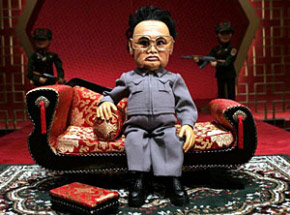
But you barely heard a peep about this, especially from the right, which should be all over this disgusting display. One of the few voices that came out against this travesty was the Wall Street Journal's brilliant Melanie Kirkpatrick. Her piece, "The Sound of Dictatorship," is right on the money. An excerpt:
Defenders of the New York Philharmonic's trip to Pyongyang this week like to chant the mantra, "It's about music, not politics." If only dictator Kim Jong Il saw it that way. In the context of a totalitarian regime, that's a naive view, not to say a dangerous one.In North Korea, the purpose of music, like that of all the arts, is to serve the state. Maestro Kim Jong Il -- who in his youth oversaw the transformation of North Korean cinema, opera and performing arts into "revolutionary" forms -- understands that mission full well. It remains to be seen how he'll use the Philharmonic's concern internally -- North Koreans were informed of the visit only on Friday. But performances of international arts groups are routinely portrayed as admiring vassals carrying tribute to the Great Leader, so there's little reason to think the Philharmonic will rate different treatment. His aim for external consumption is already clear: to give the impression that his barbarous regime is civilized. Look, we even appreciate great Western music played by one of the world's most eminent orchestras.
For a glimpse into the kind of music that North Koreans are accustomed to hearing, consider the concert that took place 10 days ago at the East Pyongyang Grand Theater, the venue where the Philharmonic tonight will play Gershwin's "American in Paris" and Dvorak's "New World Symphony" under the baton of Lorin Maazel. The occasion was the national holiday celebrating Kim Jong Il's 66th birthday. Among the pieces performed by the State Symphony Orchestra was "The Sound of a Horse's Hooves on Mt. Paektu." Paektu is the sacred mountain that Kim hagiographers claim as his birthplace. (In fact he was born in Russia.) Also on the program was Kim's personal anthem, "No Motherland Without You." Its lyrics include:
Even if the world changes hundreds of times
People believe in you, Comrade Kim Jong Il!
We cannot live without you.
According to Kim Young-nam, a composer who escaped from the North 10 years ago, songs extolling Kim and his father, "Eternal Leader" Kim Il Sung, are performed far more often than "Aegukka," the national anthem. . . .
In a telephone call from Seoul, Kim Young-nam describes his training at a music college in a provincial city he prefers not to name for fear of endangering family members and former colleagues. "In every art form in North Korea," he says, "you have to emphasize the party line and national pride. There is this framework that you have to adhere to. . . . Everything we composed had the goal of extolling Kim Il Sung and Kim Jong Il. The end production of my work was to praise socialism. . . .The performing arts are merely a means to a political objective."
Kim Young-nam recalls two friends who were arrested and punished for playing illegal music. One, he says, was a guitarist caught singing a Korean-language version of Frank Sinatra's hit, "My Way." The other was a pianist who dared to play Irish music. Disco, tango and jazz, he says, "are banned because anything that would produce a capitalist mindset such as love or indulgence are prohibited."
Posted by Debbie on February 29, 2008 05:01 PM to Debbie Schlussel